ଚିକିତ୍ସା ଏବଂ ବିକିରଣ ପଦାର୍ଥ ବିଜ୍ଞାନ କେନ୍ଦ୍ର
ଜାତୀୟ ବିଜ୍ଞାନ ଶିକ୍ଷା ଏବଂ ଗବେଷଣା ପ୍ରତିଷ୍ଠାନ

चिकित्सा एवं विकिरण भौतिकी केंद्र
राष्ट्रीय विज्ञान शिक्षा एवं अनुसंधान संस्थान

Centre for Medical and Radiation Physics
NATIONAL INSTITUTE OF SCIENCE EDUCATION AND RESEARCH


CMRP Facilities

    • And more to come...

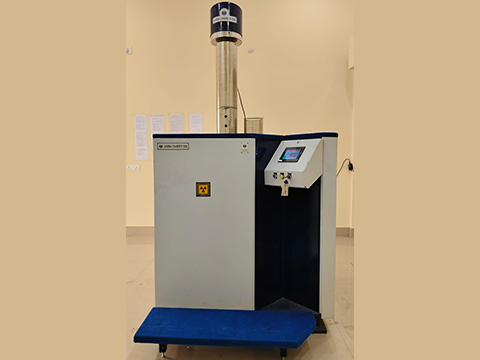
Gamma Irradiation Chamber (GIC) Facility

GIC

The Gamma Irradiation Chamber is a self-contained, dry-source storage irradiator (Category I) that contains sealed gamma-emitting Co60 radioactive sources. These Co60 radioactive sources are arranged around an annular cylindrical cage. There are 16 such pencil sources, and each pencil source consists of Co60 pellets. This was developed by the Board of Radiation and Isotope Technology (BRIT), India, and adheres to international safety standards, including American National Standards (ANSI) and International Atomic Energy Agency (IAEA).

Its compact, self-shielded design provides high dose rates with consistent exposure, making it highly suitable for laboratory and research applications.

Some Key features of the machine are given below:

Radioactive SourceCo60 pencil
Energy1.25 MeV
Dimension of Sample Chamber17.2 cm (⌀), 20.5 cm (h)
Irradiation Volume5000 cc
Maximum Dose Rate~ 9kGy/hr at the centre
Minimum time of Irradiation6 seconds (~ 28Gy Dose)
Shielding MaterialLead and Stainless Steel

How does it work?

The GC-5000 is equipped with a sample holder mounted in a vertical drawer system. During operation, the vertical drawer moves downward, drawing the sample into the shielded vault containing the Co60 sources. The sample remains inside the irradiation zone for the preset time as required by the user. During this period, gamma rays emitted by the Co60 sources irradiate the material evenly, ensuring a uniform dose distribution. After the irradiation cycle is complete, the drawer automatically returns to its original position for safe removal of the sample.

Applications

Some typical uses of the GC-5000 irradiator include:

  • Radiation effects on materials - Can be used to study the changes in chemical or physical properties of different materials due to irradiation.
  • Radiobiological studies - It helps to study the biological effects of gamma radiation on cells, microbes and living organisms.
  • Agriculture - It helps to study the effect of gamma irradiation on plants, such as the growth of plants, crop yield, resistance to natural calamities, etc, by introducing genetic mutations.
  • Small-scale sterilisation - In small-scale, it can also be used to kill harmful microbes and pathogens, to extend the shelf life of crops, vegetables, fruits, processed food products, etc.

One More Facility

Yet Another Facility